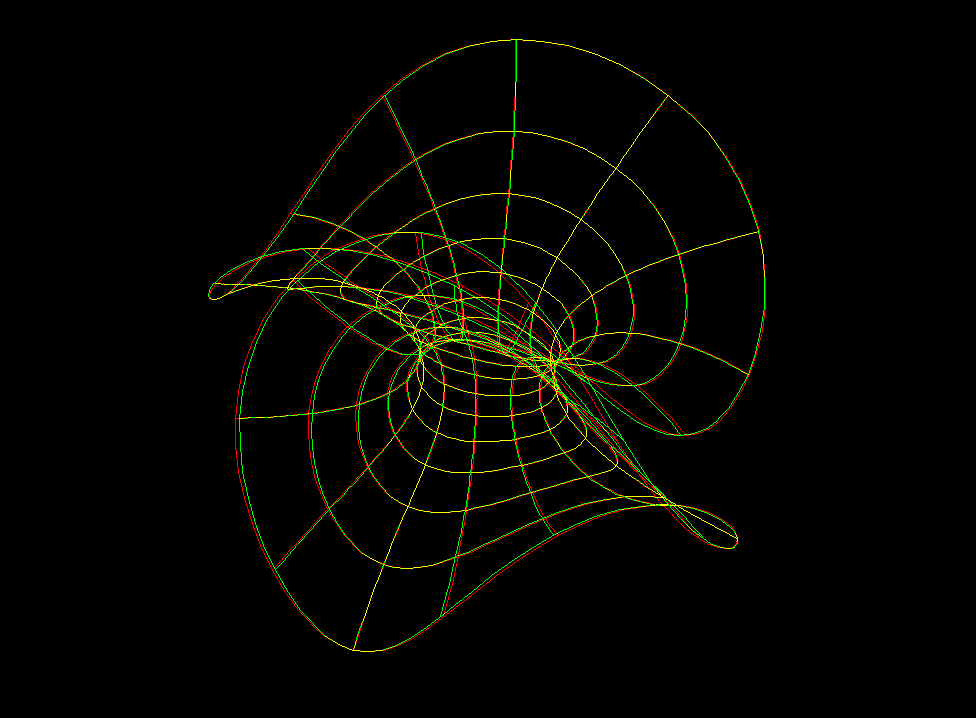
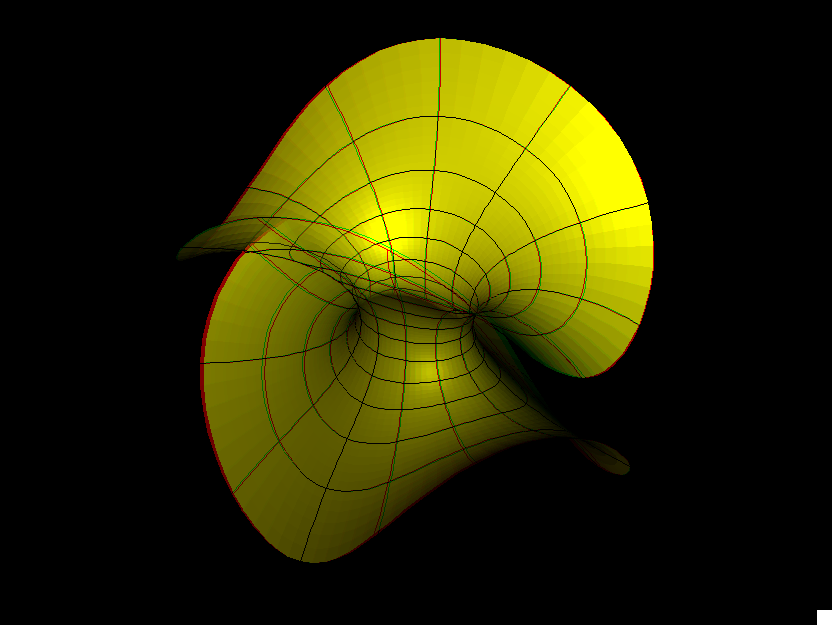
Additional images: Anaglyph, Anaglyph Wireframe, Parallel Stereo
About Double Enneper
H. Karcher
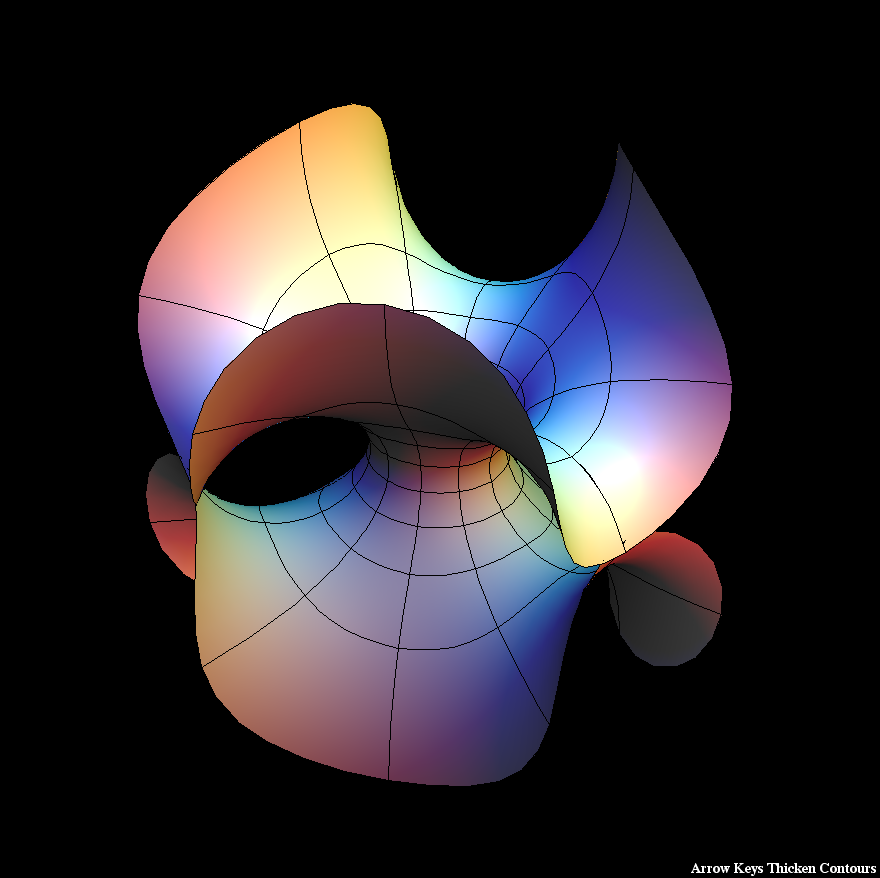
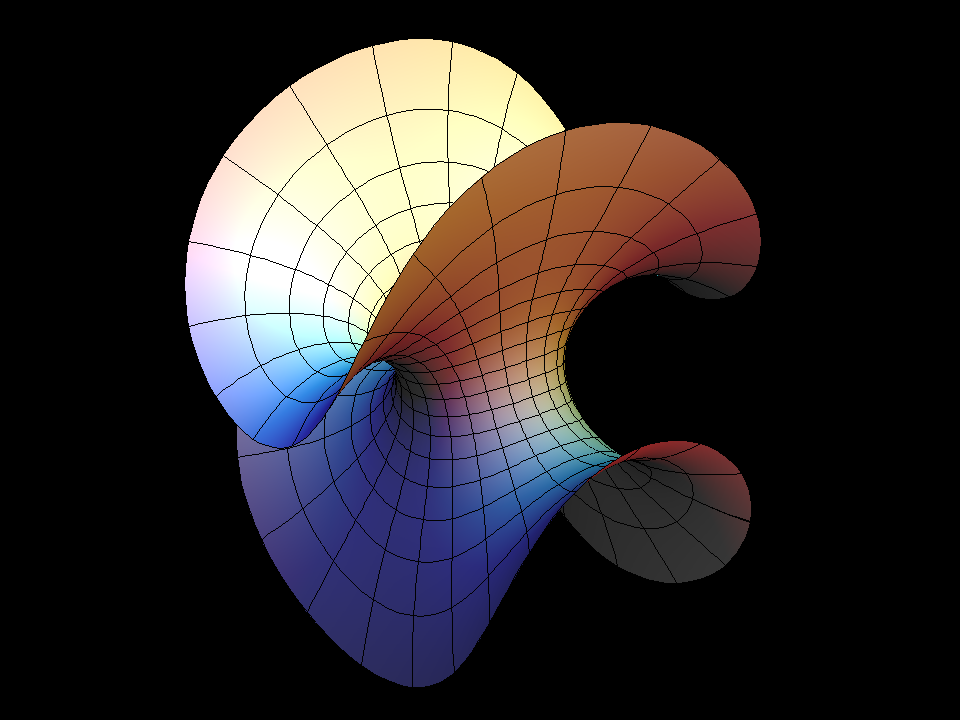
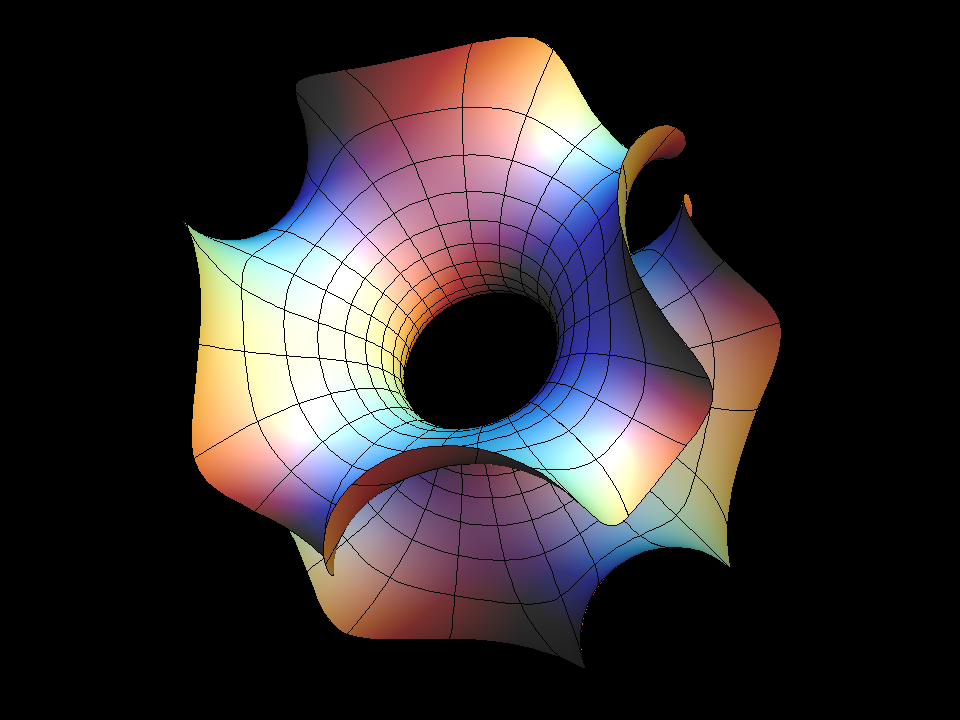
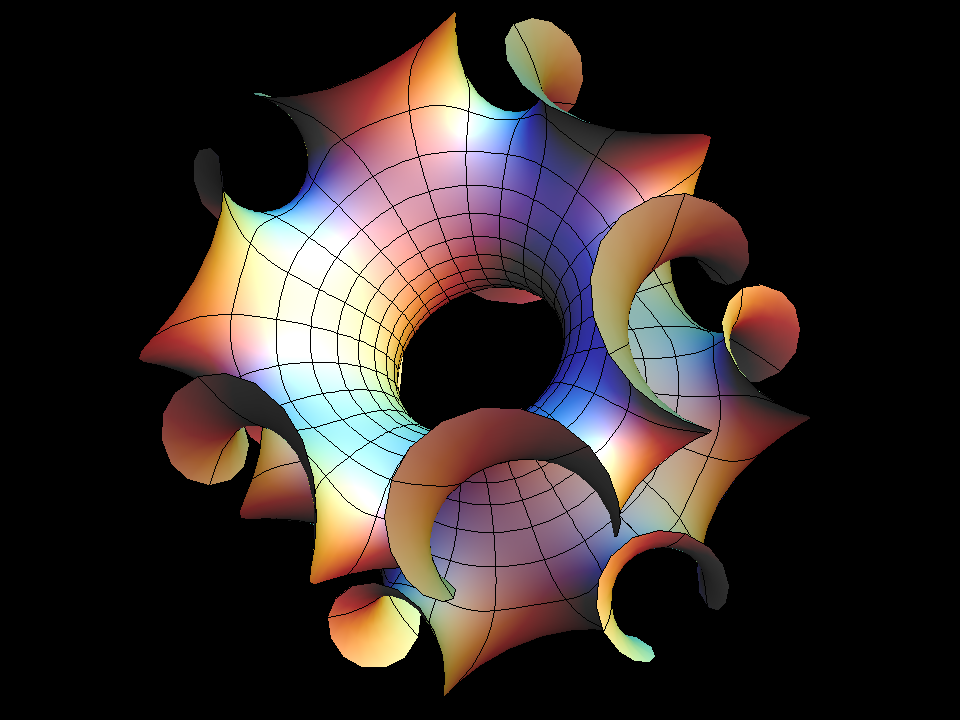
The surfaces Wavy Enneper, Catenoid Enneper, Planar Enneper,
and Double Enneper are finite total curvature minimal immersions
of the once or twice punctured sphere---shown with standard
polar coordinates. These surfaces illustrate how the different
types of ends can be combined in a simple way.
The pure Enneper Surfaces (Gauss(z)=z^k ) and the Planar
Enneper Surfaces have been re-discovered many times, because
the members of the associate family are CONGRUENT surfaces
(as can be seen in an associate family morphing) and the
Weierstrass integrals integrate to polynomial (respectively)
rational immersions. Double_Enneper was one of the early
examples in which I joined two classical surfaces by a handle.
In this example the parameter aa controls the size
of the neck between the top and bottom Enneper ends
(it should be kept in the range 3 < aa < 7). The parameter
bb rotates the top and the bottom ends relative to each other,
and umin and umax control how far into the ends one computes.
Try a cyclic morph with the default parameters (this rotates
the upper and lower ends in opposite directions). We also
suggest morphing the size (aa) of the handles.
Formulas are taken from:
H. Karcher, Construction of minimal surfaces, in "Surveys in
Geometry", Univ. of Tokyo, 1989, and Lecture Notes No. 12,
SFB 256, Bonn, 1989, pp. 1--96.
For a discussion of techniques for creating minimal surfaces with
various qualitative features by appropriate choices of Weierstrass
data, see either [KWH], or pages 192--217 of [DHKW].
[KWH] H. Karcher, F. Wei, and D. Hoffman, The genus one helicoid, and
the minimal surfaces that led to its discovery, in "Global Analysis
in Modern Mathematics, A Symposium in Honor of Richard Palais'
Sixtieth Birthday", K. Uhlenbeck Editor, Publish or Perish Press, 1993
[DHKW] U. Dierkes, S. Hildebrand, A. Kuster, and O. Wohlrab,
Minimal Surfaces I, Grundlehren der math. Wiss. v. 295
Springer-Verlag, 1991
Supporting files:
Description in PDF