I was born in Montreal in 1954 and have lived all my life in that beautiful city. Circumstances forced me to leave school after twelve years, but because I have always been interested in science and art, I continued to study them on my own, and became interested in plasma, high voltage, electronics, and computer science. While still young, between 17 and 21 years of age, I produced some metal sculptures as well a jewelry made from diverse materials.
My professional career has been in the field of TV productions, mostly news and public affairs shows for a French-Canadian TV network. Over the years I have worked both as a film engineer, conceiving, installing, and maintaining film equipment, and also as cameraman and soundman and since 2000 I have also worked as an Avid video editor.
As the power of computers increased, I started to use fractals as the raw material for my artistic visual creations, mostly using the software of
Stephen Ferguson and
David B. Sprangler Smith. And because I prefer to understand what is behind the tools that I use, I also took a short course on fractals with Kerry Mitchell of the University for Advancing Computer Technology.For some years now I have worked with 3D modeling software, mostly
Bryce and
Carrara, and also the freeware mathematical visualization program
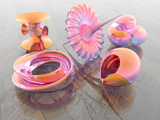
3D-XplorMath. Using 3D imaging techniques, I try to present interesting mathematical objects and concepts in a visually appealing environment. My friendship and collaboration with the mathematician
Richard Palais, the creator of 3D-XplorMath, has been a determining factor in my recent artistic orientation. We have worked together on many projects, and in 2006 we won First Place in the illustration category of the
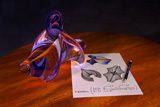
National Science Foundation/Science Magazine Visualization Challenge with this
image, which was used as the cover illustration for the September 22, 2006 issue of
Science Magazine. We again won a First Place in this same annual
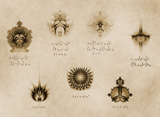
international competition, in 2009, with this
image and participated together in the
Imaginary2008 exhibition. This web site gallery that we call the
Virtual Mathematical Museum, is yet another project were we work together.